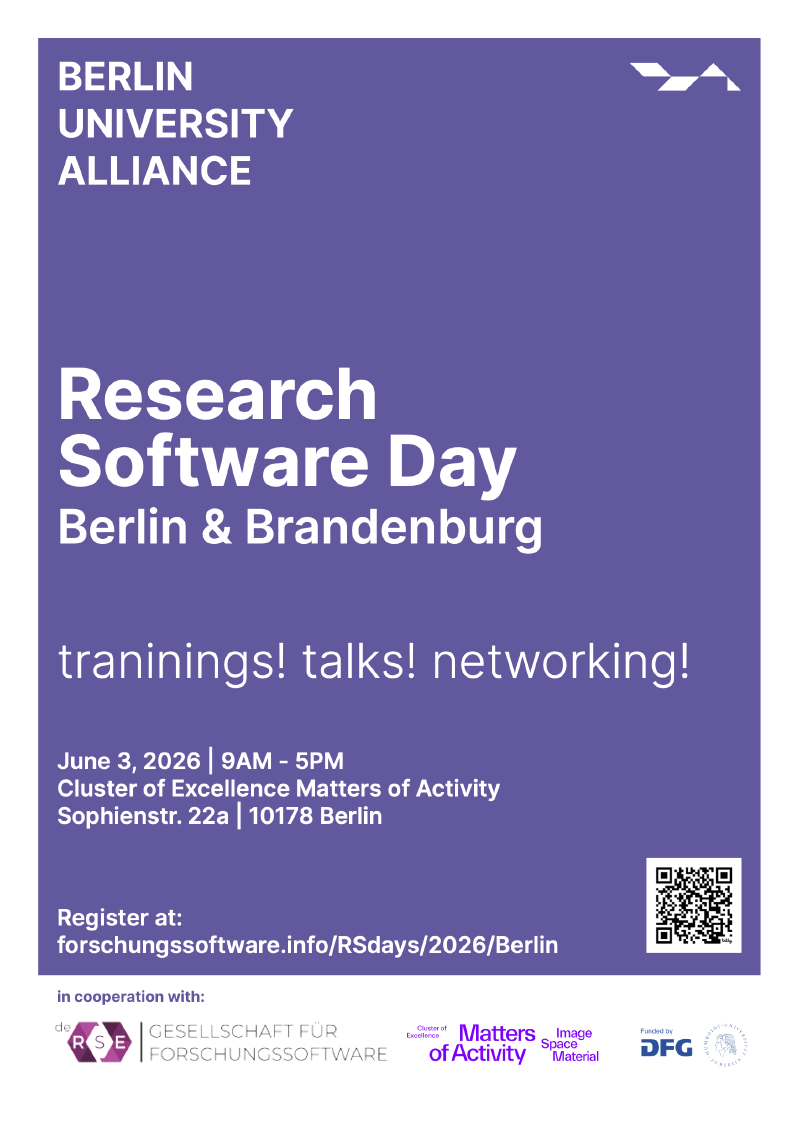
First Research Software Day Berlin & Brandenburg, 3 June 2026#
Update: Material has been uploaded to this Zenodo Community. If you want to shape future RS Days in the area, please join the mailing list.
We are pleased to invite you to the Research Software Day Berlin & Brandenburg, which takes place in Berlin on June 3, 2026.
The event brings together researchers who (want to) develop software, networking and training initiatives for research software engineering, computer scientists interested in this domain, as well as RDM teams, data stewards, librarians and other research managers who are increasingly confronted with software questions.
The aim of the Research Software Day is to learn, share and strengthen local communities around research software as a key component of open and responsible research. It is organized by the Berlin University Alliance (BUA) and the de-RSE e.V. – Society for Research Software in Germany, in cooperation with the Cluster of Excellence Matters of Activity. In addition to the face-to-face event on June 3, online training events are organized during the whole week of June 1-5, 2026 (the first ever Research Software Week in Germany!).
Registration closed on 2026-05-05. To be placed on the waiting list please send an e-mail to core@berlin-university-alliance.de. Thank you for your interest. » Please register here until Mai 19th for the Research Software Day 2026.
Schedule (see abstracts below)#
| Time | Details |
|---|---|
| From 08:30 | Arrival & Coffee |
| 09:00-12:00 | Session 1: Hands-on Trainings |
| 2.04/2.05 | (1.1) Rechtsfragen bei Forschungssoftware: Urheberrecht, Open Source, Lizenzen und Compliance (in German language) Till Kreutzer (iRights) |
| 2.20 | (1.2) National High-Performance Computing (NHR): HPC and AI at NHR@ZIB Steffen Christgau, Anirudh Krishnadas and Georgios Nikolis (all ZIB) |
| Central Lab | (1.3) How to create better code for better research? Where Small Steps Make Big Differences in Software Quality and Workflow Quality Robert Casties (MPIWG), Julia Damerow (Arizona State), Daniel Nüst (TU Dresden), Malte Vogl (MPI Geoanthropology) |
| 12:00-12:45 | Lunch Break |
| 12:45-13:00 | Welcome Prof. Manfred Hauswirth (Steering Committee BUA Objective 3 Advancing Research Quality and Value, TU Berlin, Fraunhofer FOKUS, Weizenbaum-Institut) |
| 13:00-13:45 | Keynote: “Better Software, Better Research”: How Research Software Engineering (RSE) Improves Scientific Practices Prof. Anna-Lena Lamprecht (Universität Potsdam) |
| 13:45-14:30 | Networking and Coffee with booths by - FuturRSI - Research Software Engineering Award der Klaus Tschira Stiftung - Open Research Office Berlin - Wikimedia & Research Software Discovery - Digital Humanities Berlin |
| 14:00-14:30 | Matters of Activity Showroom tour |
| 14:30-15:30 | Session 2: Workshops, Talks and Meetups |
| 2.20 | (2.1) Unveiling the Iceberg: Enhancing the Quality and Visibility of Research Software at Helmholtz Antonia Schrader (Helmholtz Open Science Office) |
| Central Lab | (2.2) Connecting the Dots: Publications, Data, Models, and Code in the GenAI Era Prof. Sonja Schimmler (TU Berlin, Fraunhofer FOKUS, Weizenbaum-Institut), Dr. Angelie Kraft (Weizenbaum-Institut) |
| 2.19 | (2.3) RSE Education: Into the Light Julian Dehne (GI), Magnus Hagdorn (Charité), Nick Del Grosso (University of Bonn, ibehave.nrw) |
| 2.04/2.05 | (2.4) Reproducible Computational Analyses Jochen Knaus (Weizenbaum-Institut) |
| 15:30-16:00 | Coffee Break |
| 16:00-17:00 | Session 3: Workshops, Talks and Meetups |
| 2.20 | (3.1) From Experiment to Ecosystem: HU’s AI Service Infrastructure Malte Dreyer (HU Berlin) |
| 2.04/2.05 | (3.2) AI Research Governance. Responsiblity, regulation and guidelines in context of research developments Carolin Odebrecht (HU Berlin) |
| 2.19 | (3.3) 20 years of Open Source - lessons learned Max Moorkamp (TU Berlin) |
| Central Lab | (3.4) Open Networking. Visit the booths! |
| 17:00-17:15 | Wrap-up and Closing |
Location#
Cluster of Excellence Matters of Activity at Sophienstr. 22a, 10178 Berlin
- wheelchair accessible
- Open Street Map or Google Maps
- in the 2nd backyard turn right and use the elevator or stairs to the 2nd floor and turn right into our central lab
- Nearby public transport: U8 Weinmeisterstraße, S Hackescher Markt, Tram M1 Weinmeisterstraße/Gipsstraße, train station Alexanderplatz
- parking spots for bicycles only (2nd backyard)
Funding#
The BUA and their Center for Open and Responsible Research (CORe) and Open Science Ambassadors Program cover the costs for the RS Day and have staff assigned to the event organization.

The event is greatly supported by the de-RSE association.

We gladly acknowledge local support from the Cluster of Excellence Matters of Activity.

Contact#
For questions, feedback, etc. please contact Claudia Göbel and/or Alexander Struck.
Abstracts#
Session 1: Hands-on Trainings (09:00-12:00)#
(1.1) Rechtsfragen bei Forschungssoftware: Urheberrecht, Open Source, Lizenzen und Compliance (in German language) Till Kreutzer (iRights) Der Workshop bietet einen praxisnahen und allgemeinverständlichen Überblick zu rechtlichen Aspekten des Softwareschutzes, insbesondere in Bezug auf Freie und Open Source Software (FOSS). Mit Fokus auf den wissenschaftlichen Kontext werden insbesondere urheberrechtliche Ausgangsfragen, die Systematik, Funktionsweise, sowie typische Lizenzpflichten von Open-Source-Lizenzen, Copyleft- und License-Compliance-Aspekte beleuchtet. Ziel ist es, Orientierung beim rechtssicheren Umgang mit Forschungssoftware in der täglichen Arbeit zu geben und rechtliche Risiken besser einordnen zu können. Es wird viel Raum für Nachfragen und Diskussionen geben.
(1.2) National High Performance Computing (NHR): An Introduction to the NHR@ZIB Site Georgios Nikolis (ZIB), Steffen Christgau (ZIB) The National High‑Performance Computing Initiative (NHR) offers free, large‑scale computational resources and topic‑specific consulting to scientific projects at public universities across Germany. With nine sites nationwide, the NHR is a key partner for researchers who require high‑performance computing (HPC) at scale. The Berlin node—NHR@ZIB—resides at the Zuse Institute Berlin (ZIB) and operates the LISE supercomputer. In this session we will present an overview of the NHR’s mission, governance and infrastructure, followed by a detailed look at the services available through NHR@ZIB. We will illustrate how HPC and AI are applied in natural and life sciences through concrete use‑case examples, highlighting the impact of high‑performance resources on research outcomes.
(1.3) How to create better code for better research? Where Small Steps Make Big Differences in Software Quality and Workflow QualityRobert Casties (MPIWG), Julia Damerow (Arizona State), Daniel Nüst (TU Dresden), Malte Vogl (MPI Geoanthropology) When in the research lifecycle do small interventions yield the largest gains in code, workflow, and research quality? This hands-on session explores that question by combining two complementary initiatives: CODECHECK https://codecheck.org.uk/, which independently checks computational workflows as part of peer review, and the DHTech Code Review Working Group https://dhcodereview.github.io/, which provides collaborative code review for in-progress research software. After introducing both initiatives, we examine diverse perspectives on what “good software/workflows” means in research contexts, discuss incentives and benefits, and identify practical, low-barrier quality improvements that individual researchers/developers as well as communities can adopt.
Session 2: Workshops (14:30-15:30)#
(2.1) Unveiling the Iceberg: Enhancing the Quality and Visibility of Research Software at Helmholtz Antonia Schrader (Helmholtz Open Science Office) Open research software is central to transparent and reproducible science: only when both research data and program code are freely accessible can results be verified, reproduced, and reused. The Helmholtz Open Science Policy serves as the institutional framework to set shared standards and grant software the visibility and recognition it deserves within the Helmholtz Association. This presentation explores how initiatives like the Helmholtz Software Award, the Research Software Directory, and the Helmholtz Quality Indicators for Data and Software Products translate this policy into practice, ensuring the professionalization of research software as a research contribution and a visible pillar of scientific excellence.
(2.2) Connecting the Dots: Publications, Data, Models, and Code in the GenAI Era Prof. Sonja Schimmler (TU Berlin, Fraunhofer FOKUS, Weizenbaum-Institut) Generative AI is reshaping the research landscape, making transparency and reproducibility more critical than ever. As AI-augmented research cycles rise, this shift concerns all digital artifacts: publications, data, models, and code. This one-hour session explores the essential competencies and infrastructures required for this new era, featuring insights into the NFDI (National Research Data Infrastructure) and Data Competency Centers. Designed for both beginners and experts, the session opens with lightning talks on how GenAI reshapes science and redefines the necessary competencies and infrastructures. This transitions into a hands-on session, where participants engage in peer-to-peer discussions to navigate complex transparency and reproducibility challenges. The session culminates in a collaborative synthesis, drafting an outline for a joint paper to ensure a tangible community contribution.
(2.3) RSE Education: Into the Light Julian Dehne (GI) RSE Education has started out in some dark corners. PhD students may have had some practical tips from their supervisor. Colleagues meet online, and Stackoverflow has been relevant in building communities of interest. With the rise of the field, RSE education has stepped more and more into the light. First, mentoring and consulting was professionalized. Magnus Hagdorn talks about the Capentries and how they have shaped the RSE community as educators. Next, RSE education as a service was invented to move RSE workshops away from the central IT units toward a more method and research-centric support infrastructure. Nick del Grosse is going to talk about his experience leading such as service group and how he perceives RSE education from that angle. Finally, RSE education is stepping into the light fully by getting recognized and institutionalized as university classes. Julian Dehne talks about his experience coordinating the effort for guidelines for an RSE master as well as his two first RSE-classes taught in 2026 at RWTH.
Building Research Software Capacity with Training-Focused RSE Infrastructure: Experiences from the iBOTS Project Nick Del Grosso (University of Bonn, ibehave.nrw) The iBehave Open Technology Support (iBOTS) group at the University of Bonn builds research software engineering capacity for neuroscience through embedded consulting, practical training, and reusable teaching materials. Using a training-driven philosophy, we support more than 40 labs to help researchers move from fragile scripts to reproducible workflows with Python, Git and GitHub, workflow automation, and data management practices. This talk introduces our service model, teaching and support formats, and the lessons we have learned about scaling community, improving software quality, and making open, sustainable research computing visible in academic work across diverse teams and projects.
(2.4) Reproducible Computational Analyses Jochen Knaus (Weizenbaum-Institut) The replication and reproduction of scientific results and methods constitute good scientific practice. Despite the fact that software and research software are now deeply embedded in mostly all processes throughout the scientific lifecycle in many scientific domains, this technical aspect is often overlooked: the results of software, despite their nominally deterministic nature of computer programs, is stable, but reproducing them is not guaranteed per se, but require adjustments to methodology and design. This becomes all the more evident when considering the entire class of research software, from a single statistical analysis to infrastructure components, over an extended period of time: can computational results performed with software still be reproduced with reasonable effort even years later? And if not, why not? This talk provides an overview of various challenges and solutions: from individual aspects in the programs, using data formats and data preparation, the use of software libraries and (commercial) third-party software, to approaches using dynamic documents and reproducible workflows, all the way to the technical preservation of entire execution environments. Current topics such as the integration of external AI systems, agents, and Vibe Codings will also be addressed from the view of reproducibility, as well as the status and practices of computational reproducibility within the scientific publishing system will be examined.
Session 3: Workshops (15:45-16:45)#
(3.1) From Experiment to Ecosystem: HU’s AI Service Infrastructure Malte Dreyer (HU Berlin) This talk outlines the development of the AI infrastructure at Humboldt University of Berlin since 2023: from the first locally deployed language model to today’s comprehensive ecosystem comprising privacy-compliant LLMs and encoders, multimodal tools (transcription, image analysis, image generation, document summarisation) and integrations with other services. A key factor in its success is the operating model, which does not log personal data whilst ensuring API availability for in-house applications – complemented by the interactive ‘AI Teatime’ format, which feeds user requirements directly into development. The infrastructure is complemented by formats designed to promote AI literacy and platforms for Retrieval Augmented Generation (RAG) to create agent-based interaction formats in the fields of research, teaching and administration.
(3.2) AI Research Governance. Responsiblity, regulation and guidelines in context of research developments Carolin Odebrecht (HU Berlin) Birds of a Feather (BoF) discussion session on AI governance targeting all levels of developers and engineers in academic research environments, addressing individual accountability, responsibility within teams and institutions, organizational governance frameworks, and necessary conditions for responsible AI development in scientific contexts. This informal forum aims to foster exchange also on ethical considerations and practical implementation challenges specific to software development and AI responsiblity in university settings. We will discuss existing governance approaches across organizational levels and actionable recommendations for responsible AI practices.
(3.3) 20 years of Open Source – lessons learned (tbc.) Max Moorkamp (TU Berlin) Publishing research software as open source facilitates reproducibility of results, enhances visibility and can be a rewarding experience. However, it is also a daunting endeavor to make software often written for very specific use cases open to the public. For example, as scientists we focus on correctness of results and computational efficiency, but tend to neglect usability, the ease of building software on different platforms and documentation. I will reflect on my experience with making software available for the last 20 years. What has worked? What have been significant obstacles to better use of software? How has publishing my software as open source influenced my career and my research? What might the next 20 years look like? Abstract is under discussion and will be published soon.
There are no articles to list here yet.